
Body, Mind, and Soul
Paramahamsa Prajnanananda · Source: Yoga: Pathway to the Divine
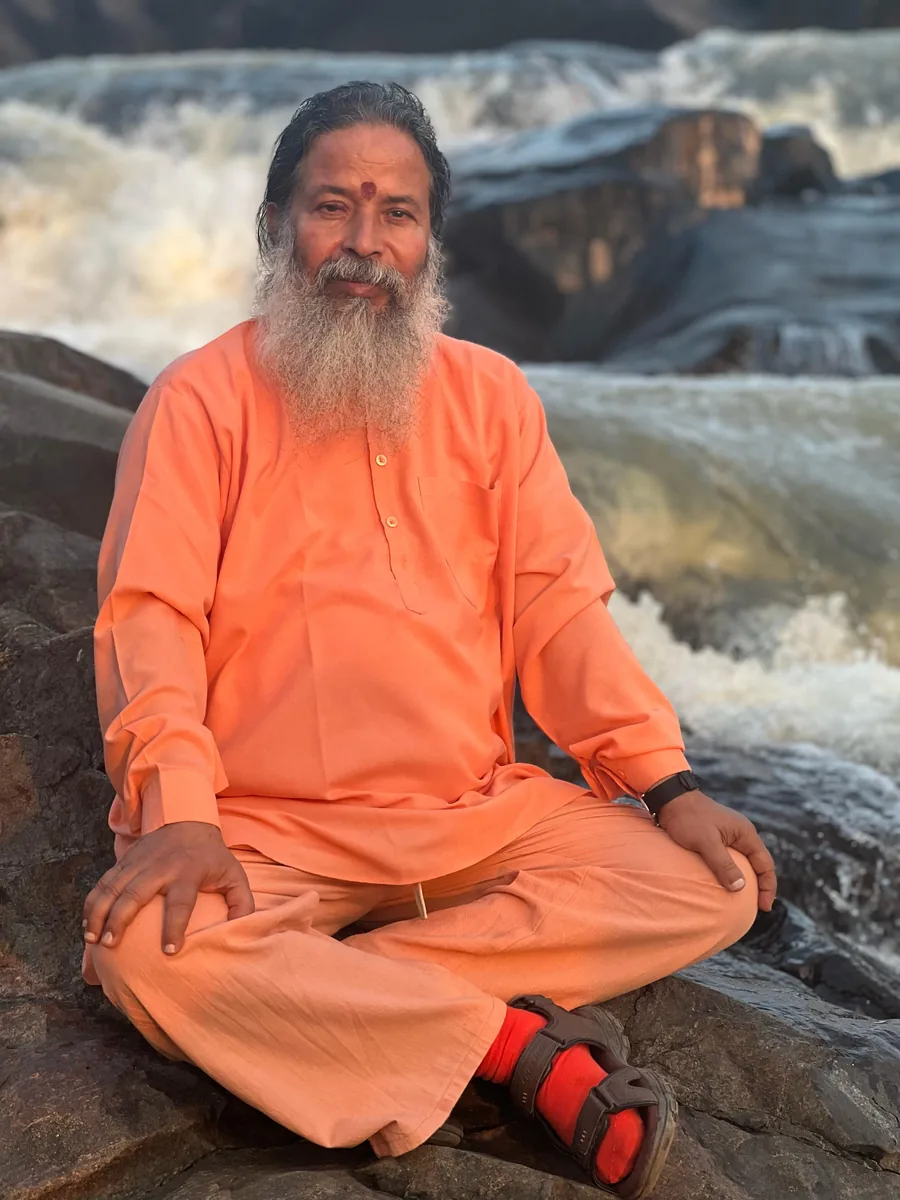
Introductory Reflection To obtain the precious clarified butter within, the body has to be heated by the inner fire of meditation. We can stoke the inner fire of meditation by concentrating in the region between the ajna chakra and fontanel. First, heat the milk of life by practicing deep, relaxed breathing, then the cream will emerge. Maintain silence in the mind as well as stillness in the body in order to convert the cream into butter. As we dive deeper in our meditations, we seek to obtain the clarified butter and make it pure enough to burn completely in the fire of wisdom.
There is a special variety of deer called musk deer. A heavenly fragrance emanates from its body, but not knowing its source, the deer vainly searches here and there to discover where the sweet scent is coming from. Similarly, we all are searching for the source of happiness by looking out into the external world through our extroverted senses, forgetting to search within.
How can one reach the source if one does not know how to search? We have come to this world for a short period of time and we will soon have to return from where we have come, so what is the aim of this short stopover on planet Earth? What is the purpose of life? Why did we obtain a human body and not the one of an animal or a plant?
If we discover the correct answers to these questions, most of our life's problems will dissolve. To understand the goal of life you should ask yourself the following questions: “Who am I? Why do I meditate? What is the purpose for studying the scriptures or going to temples, synagogues, and churches? What underlying reason prompted me to dedicate my time to a specific spiritual practice?” Earnestly inquire whether you are honestly and sincerely striving to achieve the highest goal in life and by what means.
Human life is constituted by the soul, which is ever pure, divine, immortal, and luminous; the body, which is limited and impermanent; and the mind which stands as the main obstacle in between the body and the soul.
Each human body is made of the five primary elements: earth, water, fire, space, and air. In the Bible it is said that God created man in His own image out of dust and breathed into his nostrils the breath of life. It is no coincidence that God picked dust and not any other material. Dust is the symbol of the five elements.
The human body, as well as those of animals and plants, undergoes six modifications: it is born, exists, grows, ceases to grow, decays, and eventually, it dies. Though growth is a body's natural phenomenon, the body's growth has a certain limit. With time the body undergoes decay, hair turns gray, eyesight decreases, and the overall strength and vitality diminishes until, ultimately, the body dissolves into dust. The very idea that our body has to face decay and death may not be pleasant, but it is a reality we have to accept.
What is this body we give so much importance to?
The scriptures give quite a variety of singularly different interpretations and comparisons to understand the role and the impermanent nature of the body. The Katha Upanishad says the body is a chariot. In modern terms we could compare it to a car. This body is a horse-driven chariot and the senses are the horses that draw this body chariot. If the senses are not well-trained, one risks jeopardy, but if disciplined, one can smoothly and safely reach the goal.
The body is also compared to one's clothes. The soul wears the body as a garment that one changes when it wears out. As when you change your clothes, you remain the same person, similarly, we change the body garment, but the soul remains unaffected.
It is important to take due care of our body so that it may allow us to reach the goal, but we should not be too attached to the body.
The human body is the reflection of our own mind. If our mind is peaceful, angry, or anxious it is reflected on our face. Our face is the mirror of our thoughts, words, and activities. If our mind is strong, the body will be strong; if our mind is healthy, our body will be healthy. It is therefore essential to transform our mind, so that our body may be in excellent physical condition.
This body is the opportunity we were given to work out and exhaust our past karma in order to be free and achieve liberation; thus the body is the field where karma, intended as action, can take place.
Each human life is a balance of past and present karma. We have acted in the past, we are performing actions in the present, and, as a result, it is not so simple to be free from the claws of karma. One is to live wisely, being aware this human birth is a precious and rare chance to free oneself from ignorance.
The Bhagavad Gita, the Upanishads, specific yogic scriptures, and other sacred texts also portray the body as a city with many doors. The nine doors described by the Bhagavad Gita are our two eyes, two nostrils, two ears, and the mouth. These first seven openings are all present in the face, while the other two openings are at the genital organ and the anus.
In the yogic scriptures there is also mention of a tenth opening which is represented as a closed door; it is the fontanel on the top of the head. Yet in reality, one could say that the body has an infinite number of openings, as the sense of touch is spread all over the skin of the body.
We live our lives in this city with many doors for only a short period of time. Since the soul has only come to this body for a limited number of years and, when it is time, it will leave, we should strive to gain the utmost advantage from this birth. Even though we strive to realize the impermanent nature of the body, we should consider our life as God's unique and rare gift.
While the body is temporary, the soul is immortal, divine, and ever pure. In the Bible the soul is described as the image of God, and correspondingly, in the Upanishads it is affirmed that we are the children of immortality.
The soul, being present also in each atom of the body, is pervasive, and being pure energy, it is imperishable. Just like a bulb is useless without electricity, a body is inert and cannot carry out its functions without the power of the soul. Due to the presence of the soul, every cell of the body is vibrant with life.
The soul is the catalyst for the activities of the senses and the body's every functional need. The body, without the presence of the soul, would be inert. The soul, being subtler than the subtlest, is not easy to describe, but it may be perceived and experienced in meditation.
In the Upanishads it is said that, just as oil is hidden in each part of the sesame seed, butter in every drop of milk, and fire in each most minuscule particle of wood, the soul permeates each part of the body. A yogi, through meditation, can extract oil from the sesame seed and butter from milk and this process may be called applied knowledge, practical meditation.
The soul is also described as prana, the vital energy which subtly enables every single part of the body to be energetic and alive. Breath is the physical manifestation of prana.
As the body is constituted by the five primary elements, the soul may be compared to the imperceptible and unlimited space element, free from all boundaries and one with the eternal Creator. Just as space is one and the same, whether it is contained in an object or beyond objects, the soul permeating the body and God are one and the same.
The mind is the intermediate unit between the body and the soul. It is of vital importance that you strive to understand the mind more clearly. The mind is a good friend, but a confused one.
If you are vigilant and constantly watch what your mind is most frequently focused on, you will realize the priorities your mind has set for you, what attracts you the most, and what is most valuable to you.
Watch your mind through contemplation and meditation. Analyze your mind and detect which type of thoughts predominantly and repeatedly surface in your mind. In spiritual life, self-analysis is fundamental and compulsory because it reveals what type of mind you have.
The average untrained mind relentlessly and inexorably moves outwards, while a peaceful spiritual mind remains tranquil and still. A mind that has never undergone any spiritual training obstinately moves out towards the sense objects, dragged by the extrovert senses.
The mind is the only obstacle to enlightenment; yet, it is, at the same time, the only resource to set you free from ignorance.
The mind can either be a useful tool or the cause of unrelenting turmoil and chaos.
Watch your mind and use it with discrimination.
Text: Paramahamsa Prajnanananda, from the book Yoga: Pathway to the Divine.